
Public says, government, not markets should lead
The backdrop for every government committed to meeting the Paris commitments is the unrelenting impact of extreme weather and growing public belief that this crisis requires bold action. That is reflected in President Joe Biden’s determination to pass his infrastructure and climate legislation in the next week, in climate policy becoming the principal consideration in the forming of a new German government, and the British government announcing new policies to speed the transition and new opening to nuclear power. But the growing worry is combined with great uncertainty about whether either business or government is doing enough or acting on scale to address this crisis. That combination is leading publics in the leading economies to turn to government rather than markets to bring change.
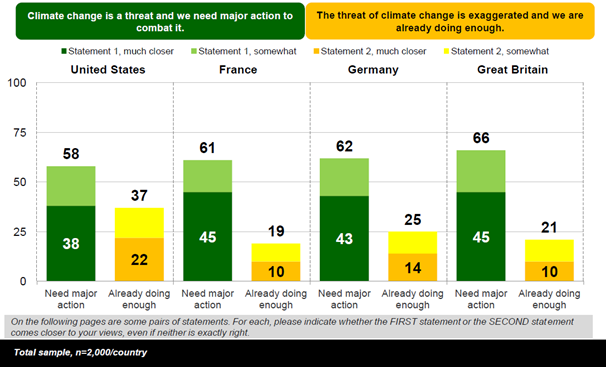
Climate Policy and Strategy is a new organization helping governments and businesses globally sustain the bold changes they have committed to. Accordingly, it conducted surveys in the United States, Germany, the United Kingdom, and France, and only Biden has benefited ’s climate policies seem bold enough to change the trajectory. Only Biden’s climate initiatives seem up to scale and translate into his being seen as stronger on the economy and in the job — assuming Congress passes the infrastructure and climate measures in the coming weeks.
The starting point is the fully 60 percent of the public in all these countries believe “climate change is a threat and we need major action to combat it,” rejecting that the threat is exaggerated. That belief reaches 77 percent of Democrats where this is a motivating issue for the mid-term elections and reaches 51 percent of moderate Republicans. Climate change is also an important issue for independents, where Biden has support in the last couple of months.
At the time of the survey in June when Biden was polling much stronger, 57 percent approved “how the government is handling climate change, the environment and the energy transition,” and even higher when respondents were informed of the policies and the debate around them. But in Germany, Angela Merkel’s disapproval on these was 13 points higher than her overall disapproval (49 percent versus 36 percent). That is probably because the public overwhelmingly supports proposals to take coal-fired power plants off the grid.

And fully 56 percent disapproved of how Macron was handling climate, the environment and energy transition. Great Britain was divided on how Boris Johnson was handling these challenges. And in both Britain and France, the predominant reason was the governments “not doing enough” or “the targets too low” and “no action or measurable improvement.”
So, right now governments are being pressed to do more, but there is no support for market solutions, like a “tax on burning coal, oil and natural gas” or even as a way “to fund the development of renewables and a sustainable economy.” Instead, they are looking for the “government to do much more” by “setting regulations to make everyone more energy efficient and invest in the innovative research to enable us to make the transition to a low carbon economy.”

Those in the business community or those looking to strengthen the US plans will not find any support in the public for pricing carbon. It seems morally and politically indefensible to have the ordinary consumer pay higher prices in the short-term after the oil and gas companies have operated profitably up until now and government has taken insufficient action. This looks even more problematic after the energy price increases coming out of the pandemic.
Has anybody noticed that President Biden and the Democrats opposed any gas tax increase and any rise in taxes for those earning under $400,000? The issue is settled in the United States and probably in Great Britain. Many European leaders now have committed to use their recovery funds to protect consumers from price increases. Perhaps it is settled in Europe too.
I think one should view the public’s skepticism about markets and turn to government playing a much bigger role as a fairly reasonable and responsible response to the way energy markets and governments have operated up until now. Neither business or political leaders begin with a lot of trust, and right now, the publics want governments to change the rules of the game and trajectory on energy use.
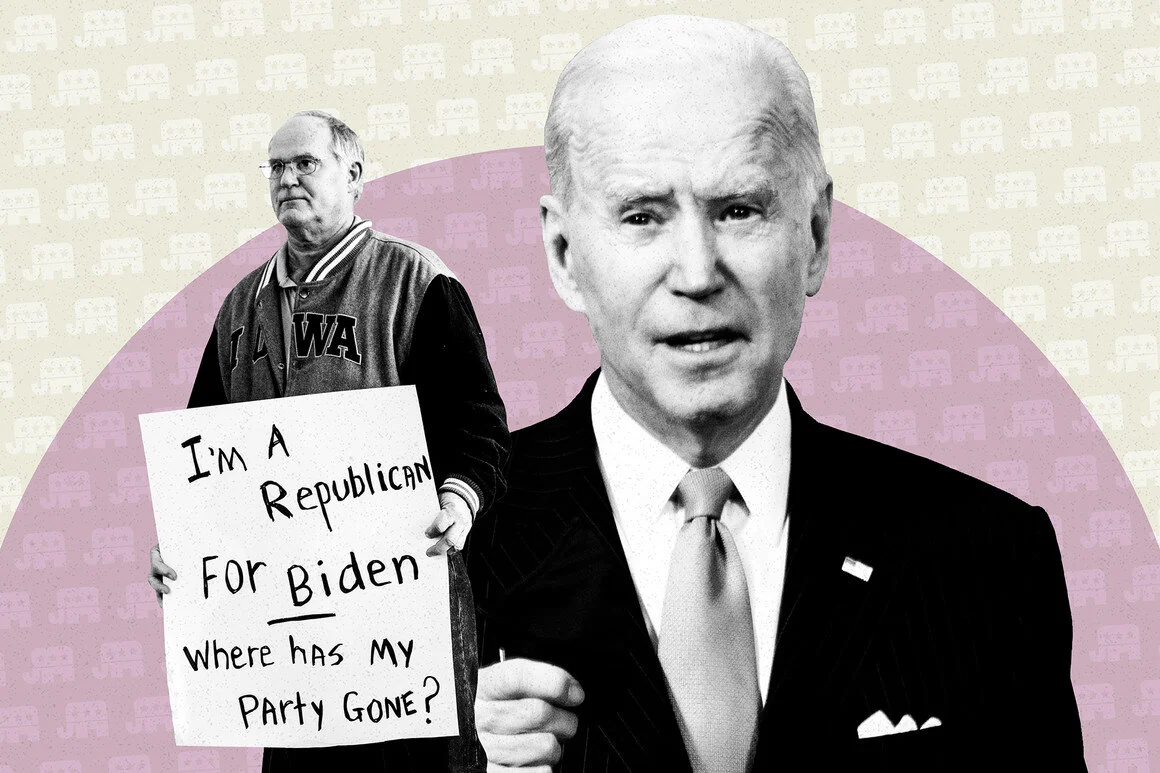
The Rise of the Biden Republicans
The pollster who identified “Reagan Democrats” in the 1980s sees the emergence of a mirror image voting bloc. And it spells trouble for a GOP dominated by Trump.
There are unwritten rules that dictate how American politics works. Former presidents shouldn’t weigh in on quotidian partisan squabbles. An incumbent senator shouldn’t support a primary challenger running against a fellow incumbent. If you’re an elected official, avoid directly comparing yourself to Abraham Lincoln—show some humility and instruct surrogates to do that on your behalf. Never try to correct a middle-schooler spelling the word “potato.” And if you want to take the pulse of white middle America, go to its de facto national capital—Macomb County, Michigan.
Every four years, as if driven by mainspring, presidents, those aspiring to be presidents and the reporters who cover them, return to the blue-collar Detroit suburbs to try out their messages and make sense of what’s happening in middle America.
Presidents will visit the community college campus in Warren—where President Ronald Reagan famously declared, “I’m a former Democrat, and I have to say: I didn't leave my party; my party left me” and where President Barack Obama announced his ill-fated American Graduation Initiative, a planned $12 billion investment in community colleges. And thick in the campaign season, candidates will swing by local factories to make major economic speeches, as Hillary Clinton did in 2016; take shots at NAFTA and celebrate new trade deals, as Donald Trump did in 2020; and hold campaign-debilitating photo ops, as Michael Dukakis did when he donned a helmet and drove around in an M-1 Abrams tank. Reporters will talk to voters at the ubiquitous Coney Island diners, hold televised roundtables with average Joes at bars and pry political chestnuts from locals wearing cutoffs and playing Euchre.
It’s been this way since the mid-1980s, when a Yale-based academic and pollster named Stanley Greenberg turned his attention from studying the interplay of class and race in apartheid South Africa to try and explain what was happening in Macomb.
The full interview can be read at Politico.
To Save America, Look at America as It Is
How modeling the electorate is critical to understanding the challenge we face
Just as the intelligence community may have missed the size, organization, and determination of Trump’s supporters to keep Donald Trump as president, the polls in 2016 and 2020 missed Trump’s ability to bring his base of white working class, evangelical, and rural voters into the electorate, to save white people from a changing America. Trump called Mexican immigrants “murders and rapists,” sent signals to the KKK, and instituted the Muslim ban. His political mission was defined by “good people on both sides,” closing the government to fund the border wall, and telling the Proud Boys to “stand back and stand by.”
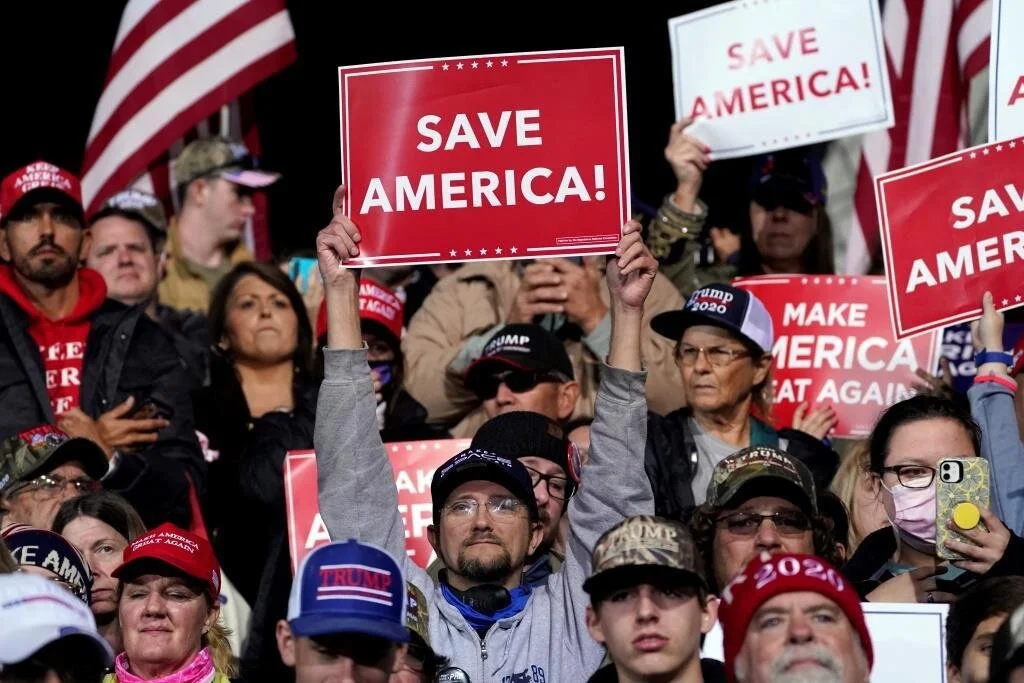
Trump won the Republican nomination in 2016 by winning over the Tea Party, evangelical, and pro-life blocs, each of them determined to save America from Barack Obama, the first Black president. His enflaming racial resentment gave Trump an unassailable base in his party. But what the general elections reveal is that 40 percent of all Americans is fully part of an anti-establishment, God-first, racially resentful, anti-democratic bloc, who live in a right-wing media cocoon and adore Donald Trump. This bloc of white rural, evangelical, and working-class male voters rushed to the polls in both 2016 and 2020. And critically, they are three of every five Republicans.
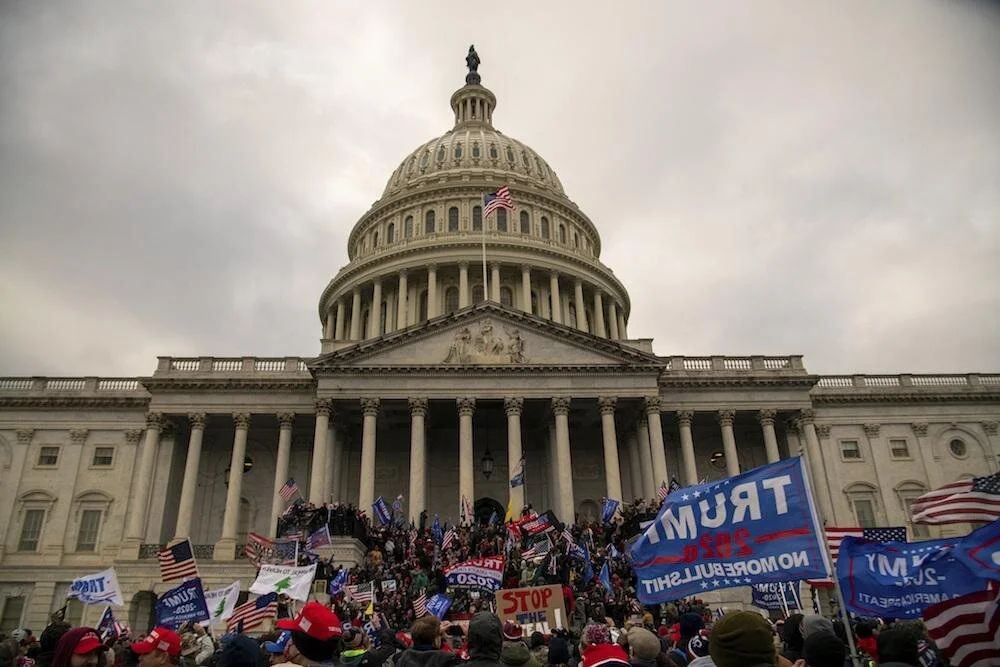
Chanting “Make America Great Again,” “U-S-A.! U-S-A!” and “Stop the Steal,” Trump’s violent vanguard assaulted the Capitol to stop the counting of Electoral College votes. Rampaging white mobs and paramilitary Proud Boys abolish any nuance, waving their Confederate, American, and Trump flags. They aren’t sure anybody but Donald Trump will be as uncompromising, racist, and anti-establishment as they desire. And they don’t think anyone else on their side can win.
The proportion of whites without a four-year college degree eligible to vote fell a point from 45 to 44 percent since 2016, and the proportion of voters older than millennials fell 8 points from 71 to 63 percent, according to post-election analysis by the Voter Participation Project and Center for Voter Information. Only Trump’s ferocious campaign, which raised white working-class turnout by 7 points, was able to neutralize the demographic trends, discredit the polls, and make the election much closer than anyone expected.
The full article can be read at The American Prospect.
Race War
Will Trump’s use of bigotry to rally anxious white voters end with his term of office?
The presidential campaign of 2020 ended in a race war between the Democratic and Republican Parties, focused on America’s history of white supremacy, the demand for racial justice, and fear of who will now lead the country at such a moment. This was a war of choice for Donald Trump and the Republican Party, and they lost. Joe Biden won by more than six million votes nationally and by the same majority as Trump achieved in the Electoral College in 2016. As president of the United States, Biden will have an outsized role in defining Trump’s corrupt and racist presidency and the issues the country must address.
The role of race in the election was a choice for Democrats, too. It was a moral choice. After the murder of George Floyd and the fatal shooting of Breonna Taylor and pervasive protest marches, Democratic leaders joined the marches and House Democrats passed the Justice in Policing Act. Joe Biden chose an African American woman as his vice president and devoted a major part of the Democratic Convention to the fight for racial justice. He closed the campaign with an ad where Biden said, “Black Lives Matter,” and promised he would address the country’s racial inequities. And after winning, he said one of his highest priorities was addressing “systemic racism.”
Campaigns are fights to define the choice in the election. Biden wanted voters to choose a leader who would get COVID under control, protect the Affordable Care Act, unite the country, and address America’s racial divide, but Trump focused relentlessly on race.
Trump attacked the Black Lives Matter protests, called out peaceful protesters as looters, defended the police no matter how extreme their abuses, and invited white nationalists and Trump supporters to liberate Democratic-run cities and states, and defend the election from being stolen in Black-run cities.
Those attacks grew more politically damaging to Democrats when peaceful protests were accompanied by looting, overnight violence, and occasional attacks on police, even when Biden forcefully condemned violence of any kind. There are, of course, varied explanations for the rise in violent crime in the major cities, but Trump does not do nuance. According to Trump, Democrats winning this election means liberals and Blacks in charge of the cities, and the breakdown of law and order.
The full article can be read at The American Prospect.

Was The Last Debate A Shitshow For Donald Trump?
The commentariat has totally missed how much the final debate has damaged President Trump and further pushed the race’s dynamic to favor Vice President Joe Biden.
The debates take place in a country where Trump’s approval and vote is stuck at 42 percent when the rest of the country decides whether they can vote for Biden. Our research showed Biden would gain from the 1st debate because of increased favorability and more saying, “he represents the middle class.” It was no surprise there was a much bigger audience for Biden town hall because the undecided are focused on him.
Trump got heard in this debate, but that was a disaster for him. Biden gained in favorability and seeing him as someone representing middle class values battling for forgotten Americans and working Americans. For each, the intense, “describes very well,” increased by 10 points after the debate.
That gain for Biden himself really affected the choice in the election. Biden increased his margin by 8 points on which candidate would improve things for the middle class, 5 points on uniting the country and 5 points, and most importantly, on getting health care costs down.
If you thought Trump did okay and Biden simply made no mistakes, then you do not know America. You need to watch how they reacted to the exchanges on “your family,” Trump minimizing the damage from COVID, Trump describing the public option as socialism and defense of Social Security, Biden calling Trump a racist and Trump claiming he’s the best president for Black Americans since Lincoln, Trump attacking Fauci, Biden talking about DACA and separating children, the cities being a disaster, Biden describing the need for minimum wage and central workers, and Biden warning Iran and Russia.
Many commentators described the 1st debate as a “shitshow,” but it was the 2nd and final that was a shitshow for Trump.
The full slide deck PDF can be downloaded at Democracy Corps’ website.