The country hates the GOP Congress: Why don't Democrats have a knock-out lead?
Date: October 23, 2017
From: Stan Greenberg and James Carville, Democracy Corps
About 9 months into his presidency, Donald Trump has settled into a historically weak job approval of 41 percent, well below his presidential vote, and with the strong disapproval over 45 percent of voters. He remains an unrepentant divider which pervades all political discourse.
Yet the most hated politicians are the Republicans in Congress, and perhaps they ought to be more of the focus as they are on the ballot in 2018. Mitch McConnell is the least popular congressional leader in Democracy Corps’ polling, followed by Speaker Ryan. Voters know that the Republicans are in charge in Congress and these are the poster children. So why do the Democrats not enjoy a stronger lead in the ballot?

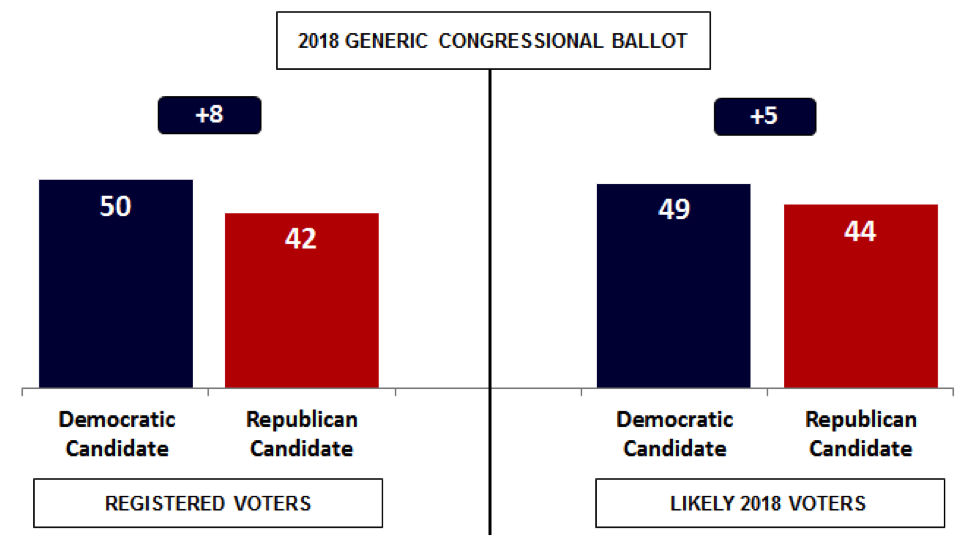
The Democrats are ahead by just 8-points among registered voters, and 5-points among likely 2018 voters in Democracy Corps’ most recent national survey. That is marginally down from the 10-point and 7-point advantages (among registered and likely voters, respectively) Democrats held in our June polling on behalf of WVWVAF. (We will release new findings on behalf of WVWVAF next week.)
The focus should be more on the GOP Congress, but contributing is the Democratic Party brand, which is unimpressive in this poll. They are viewed more favorably by just net 4-points. There has been no growth in identification with the Democratic Party, as there was in going into 2016.
This dynamic is producing a situation where self-identified Democrats, generic Democratic voters and Hillary Clinton-supporters hold their preferences with great certainty, but they are no more likely to turnout for Democrats in the off-year election, according to this poll.
A remarkable 81 percent of Democrats strongly disapprove of Donald Trump, while just 55 percent of Republicans strongly approve of his job performance. Those voting for the Democrat for Congress are more certain of their choice by 62 to 38 percent, while those voting Republican are split in their certainty (52 very certain to 48 percent somewhat certain).
Yet when it comes to the measures used to gauge interest and intention to vote, Democrats and Republicans are showing equal engagement. That will not produce the landslide election Democrats are hoping to achieve.

Maybe Steve Bannon is right that stoking the flames of identity politics creates an environment where Democrats calling for big economic change don’t get heard. We saw in the polling we recently released with Public Citizen that Donald Trump has high approval marks when it comes to ‘keeping jobs in the US’ (+27) and ‘putting American workers before the interests of big corporations’ (+7).
* * * * *
But two things catch our eye in this poll to suggest the election could take shape in very different ways by next year. First, watch the seniors and Baby-Boomers. With acute sensitivity to the impact of health care changes, seniors and Boomers are giving particularly high negative marks to Trump and Republicans. The Democrats even hold a 2-point lead in the generic ballot among seniors, breaking the age pattern that has shaped our recent elections.
Second, in our first poll testing a 2020 presidential contest between Donald Trump and Elizabeth Warren, the Senator wins by 12-points (54 to 42 percent). In coming polls, we will test other potential nominees, but that result is some measure of the real structure of the partisan balance.
Methodology: National phone survey of 1,000 registered voters conducted by Democracy Corps and Greenberg Research from September 30 – October 6, 2017. The survey was matched to voter file and 67 percent of respondents were reached by cell phones. Of these registered voters, 667 are “likely voters” in 2018. Greenberg Research maintains its own survey and weighting methods, independent of surveys released by GQRR.

How She Lost
Malpractice cost Clinton the election, but her ambivalence on big issues was produced by big structural factors that affect all Democrats.
For this and other important political and policy coverage, read this article on the American Prospect. Originally published September 21st.
Hillary Clinton’s tragic 2016 campaign faced withering criticism in the press, social media, and now, in Jonathan Allen and Amie Parnes’s inside account, Shattered. From my vantage point as lead pollster for the Democratic nominees in 1992 and 2000, part of the closing clutch of pollsters in 2004, and invited noodje in 2016, I have little quarrel with the harshest of these criticisms. Malpractice and arrogance contributed mightily to the election of Donald Trump and its profound threat to our democracy. So did the handling of the email server, paid Wall Street speeches, and the “deplorables” comment. And her unwillingness to challenge the excesses of big money and corporate influence left her exposed to attacks first by Bernie Sanders and then by Donald Trump and unable to offer credible promise of change.
Yet the accounts of Hillary Clinton are very incomplete, miss the reasons for her ambivalence, and miss most of the big structural forces at work that made it hard for her to commit to a different path. That is where we learn the most about the progressive debate ahead.
The Malpractice
The Trump presidency concentrates the mind on the malpractice that helped put him in office. For me, the most glaring examples include the Clinton campaign’s over-dependence on technical analytics; its failure to run campaigns to win the battleground states; the decision to focus on the rainbow base and identity politics at the expense of the working class; and the failure to address the candidate’s growing ‘trust problem,’ to learn from events and reposition.
Clinton’s own campaign memoir, What Happened, came out the day I was finalizing this article. She acknowledged possible errors on handling of the economy, but not these areas of malpractice.
The campaign relied far too heavily on something that campaign technicians call “data analytics.” This refers to the use of models built from a database of the country’s 200 million–voters, including turnout history and demographic and consumer information, updated daily by an automated poll asking for vote preference to project the election result. But when campaign developments overtake the model’s assumptions, you get surprised by the voters—and this happened repeatedly.
Astonishingly, the 2016 Clinton campaign conducted no state polls in the final three weeks of the general election and relied primarily on data analytics to project turnout and the state vote. They paid little attention to qualitative focus groups or feedback from the field, and their brief daily analytics poll didn’t measure which candidate was defining the election or getting people engaged.
The models from the data analytics team led by Elan Kriegel got the Iowa and Michigan primaries badly wrong, with huge consequences for the race. Why were they not then fired? Campaign manager Robbie Mook and the analytics team argued, according to Shattered, that the Sanders vote grew “organically”—turnout was unexpectedly high and new registrants broke against Clinton. Why was that a surprise?
Campaign chair John Podesta wanted to fire Mook, but Clinton stood by him. She rightly admired previous campaigns in which big data and technology were big winners, yet in 2008 it was the candidate and his appeal more than the technical wizardry that pushed Obama over the top. David Axelrod told me that analytics adds a “great field-goal kicker”—no substitute for a strategy and compelling message.
For Clinton, however, giving up the analytics team was like giving up consultant Dick Morris at earlier tough moments—a man who was thought to bring unconventional powers to play. That Mook didn’t share his results with others in the campaign reinforced his mystique as a data wizard. But that lack of transparency was malpractice. Standard practice is immediately sharing national, battleground, and state polls, as well as automated canvassing and other metrics with the senior campaign team at the very least, usually with the war room, and sometimes the whole headquarters. That is how a nimble campaign operates.
The malpractice grows exponentially with their failure to focus like a laser on winning each target primary or battleground state. Rather than shifting resources and media buys across states based on the analytics’ projection of cost per delegate or voter, they needed to focus on how to win each must-win, winner-take-all state. That meant more distinct state strategies, focus groups, and state tracking polls right to the end.
The campaign’s approach senselessly and increasingly drove up Trump’s margin in white working-class communities, tipping Michigan, Wisconsin, Pennsylvania, and Florida. The analytics model built around these assumptions was so simple-minded it portended disaster. Despite overwhelming evidence that the Democratic base wasn’t consolidated or excited, the campaign believed Trump’s tasteless attacks and Clinton’s identification with every group in the rainbow coalition would produce near universal support. Thus, they stopped trying to persuade voters and measured only the probability of support for Hillary. The campaign’s task was turning out those Clinton voters, and they fell frustratingly short.
Base and Identity at the Expense of Class
Clinton and the campaign acted as if “demographics is destiny” and that a “rainbow coalition” was bound to govern. Yes, there is a growing “Rising American Electorate,” but Page Gardner and I wrote at the outset of this election, you must give people a compelling reason to vote and I have demonstrated for my entire career that a candidate must target white working-class voters too.
Not surprisingly, Clinton took her biggest hit in Michigan, where she failed to campaign in Macomb County, the archetypal white working-class county. That was the opposite of her husband’s approach. Bill Clinton visibly campaigned in Macomb, the black community in Detroit, and elsewhere.
The fatal conclusion the Clinton team made after the Michigan primary debacle was that she could not win white working-class voters, and that the “rising electorate” would make up the difference. She finished her campaign with rallies in inner cities and university towns. Macomb got the message. “When you leave the two-thirds of Americans without college degrees out of your vision of the good life, they notice,” Joan Williams writes sharply in White Working Class: Overcoming Class Cluelessness in America.
Additionally, Sanders campaigned against bad trade deals like NAFTA and the TPP to show he’d battle for working people. NAFTA was the work of Bill Clinton and the TPP was a signature initiative of Obama. Hillary Clinton needed some distance. My wife, Representative Rosa DeLauro, headed up the anti-TPP forces in Congress, but despite her incessant lobbying of Podesta, Clinton offered only a muddled opposition.
Not Addressing the ‘Trust Problem’
Clinton’s ‘trust problem’ grew as the campaign progressed. Large numbers of voters didn’t trust her. But her campaign was reluctant or frozen in addressing it. Why? Bill Clinton, after all, faced cascading controversies in 1992 around Gennifer Flowers, his draft avoidance, and marijuana, with large majorities thinking he didn’t have the character to be president. The right had marshalled attack squads, and other Democratic candidates were pummeling him for telling voters whatever they wanted to hear in the primaries.
Shattered suggests that Obama advisers inside and outside the campaign, including David Axelrod and David Plouffe, believed Hillary Clinton herself was the principal obstacle and doubted the campaign could course-correct. Mook and team believed that identity politics, demographic trends, and Trump’s temperament would be enough to win, so they could avoid confronting the "trust problem."
What might have happened if Clinton had attended a focus group herself, as Nelson Mandela did in 1993 when our research showed that his African National Congress was seen as “out of touch” and taking too long to bring change? What might have happened if she had watched people expressing their exasperation and desperation with the economy and politicians—and talking about her ties to Wall Street and lack of truthfulness and knowing nothing of her economic ideas? But the Clinton campaign never facilitated that kind of redirection.
America’s Progress and Pain
Hillary Clinton fully identified with President Obama’s vision on identity, opportunity, honest government, inequality, the economy, and America’s upward direction, viewing his campaign and governance as successful. She stocked her campaign with his consultants and those who had worked in his White House.
She believed, and still believes, that America is dynamic, growing, and progressing, and now needs an economy that truly leaves no one behind. Inequality has worsened, but the answer is “building ladders of opportunity,” as Obama described in his State of the Union before his re-election, in his campaign speeches for Clinton, and in his private handwritten letter to President Trump.
Obama’s America was not a country in pain, but one where those left behind were looking for a seasoned leader to make progress. And Clinton only reluctantly decided to pull off this narrative. Obama and Clinton lived in a cosmopolitan and professional America that wasn’t very angry about the state of the country, even if many of the groups in the Clinton coalition were struggling and angry.
Obama’s refrain was severely out of touch with what was happening to most Americans and the working class more broadly. In our research, “ladders of opportunity” fell far short of what real people were looking for. Incomes sagged after the financial crisis, pensions lost value, and many lost their housing wealth, while people faced dramatically rising costs for things that mattered—health care, education, housing, and child care. People faced vanishing geographic, economic, and social mobility, as Edward Luce writes so forcefully. At the same time, billionaires spent massively to influence politicians and parked their money in the big cities whose dynamism drew in the best talent from the smaller towns and rural areas.
Clinton’s default position was Obama’s refrain about America, but she did invite real discussion of these issues and got close to embracing a change posture during some economic speeches and her convention address, and in the debates. But when the campaign got rocked, she reverted to the Obama narrative.
And in her book, What Happened, she acknowledges “Stan’s” argument that “heralding economic progress and the bailout of the irresponsible elites” while the working class struggled financially alienated the working class from Democrats. She says, “That’s another reminder that, despite the heroic work” of Obama, many “didn’t feel the recovery in their own lives.”
Change Requires Calling Out Big-Money Special Interests
My comments draw on my takeaways after reading Shattered, but they also draw on my personal experience with the campaign, which included regular meetings and exchanges with John Podesta. Early on, he pressed me for help on pushing back against Sanders’s Wall Street attack and asked for my reactions to Clinton’s emerging stump speech. After I worked directly with Clinton on how to close the primary, I was asked to react to the economic and convention speeches as well. Podesta asked me to email Robby Mook directly when he could not get Mook to change course at the campaign’s close.
From 2015 on, when Sanders was gaining on Clinton, I pushed Podesta, the other principals, and Clinton directly to show discontent with the state of the economy and politics and to put forward bold economic policies, like those proposed by Joseph Stiglitz and the Roosevelt Institute. On that, she often accepted that advice, though her default strategy was to “build on the progress.” And from the beginning, I called on her to decry the special-interest and big-money influence that was keeping government from working for the middle class. But on that, I got nowhere.
Early on, I chided the campaign privately for starting every economic talk with dutiful praise for Obama’s handling of the economy, and later told them not to keep saying, “America is already great.” The new American majority, I wrote, “is looking for a president who address the building problems”—and “not a third term of Obama.”
Podesta invited me to critique her comments at an Iowa town hall that he thought was “getting there,” but I was dumbfounded. “What is your core message?” I asked in an email. Clinton had said during a primary debate that Republicans will “rip away the progress and turn us backwards,” but, as I said in my email, “I think the overall message is tone [deaf] on what is happening in the country,” and that Clinton “has left the change voters to Sanders.”
I warned that Sanders was gaining by embracing our “level the playing field” message, which said that, “families and small businesses are struggling, yet CEOs and billionaires are using their lobbyists to rewrite the rules so government works for them, not you.” Sanders gained on economic change by committing to “stop any new trade deals that undermine American jobs and income.”
Sanders’s surprising strength and the damage to Clinton from his attacks on big money and Wall Street led Podesta to confer with me on how she could find her footing on reform. Clinton’s instinctive response was to go silent on the issue and attack Sanders on guns and health care. I warned in my note to Podesta, reporting a survey for Every Voice, that “billionaires, corporations and special interests buying their government is a voting issue.”
Right before the Connecticut primary, I watched Clinton and my wife, Representative DeLauro, host a café discussion with working women. Beforehand, she greeted me warmly, and afterward Rosa and I hung back in the holding area to let Clinton and I speak alone and frankly. She was really moved and disturbed by what she had heard on the campaign trail, recounting the similar stories from women in suburban Philadelphia, Tampa, and Brooklyn. “They’re in such pain. People are at their wits’ end. They feel hopeless.”
I said, yes, that is exactly what’s happening in the country, which she acknowledged, but then said, “How do I talk about their pain without sounding like I’m criticizing President Obama and his economy? I just can’t do that.”
I said, I think you can manage a different balance, and said, “Why not use your own learning from listening to these folks as a way to talk about the economy? You are about to lock up an unassailable number of delegates, why not make that learning about the economy central to this new chapter?” I promised her a note, and worked feverishly to write it overnight.
Later, when I congratulated her on her victory speech, via Huma Abedin, she wrote back, “Well you better. You inspired it!”
Embracing Pocketbook Pain—But Not Enough
After that, I was asked to look at drafts of Clinton’s economic speeches before and after the convention, as well as drafts of her convention acceptance speech. Podesta had me share my emails with Jake Sullivan and Dan Schwerin and later asked me to write a short text in her voice that uses “stronger together” but also hit my “level the playing field” points. I was asked to brief Mandy Grunwald, who was managing the debate prep.
I proposed a first point where “stronger together” means “everyone who works hard has an equal shot at America’s promise, an equal shot at joining the middle class and a better life.” But then I took my best populist shot:
We are stronger together, yet so many of our corporate and political leaders seem content to pursue their own goals, while so many hard-working people are struggling and don’t have an equal shot at a better life.
The campaign’s response was completely schizophrenic. After Clinton delivered her economic speech in Columbus, I wrote to Podesta: “President Obama could have delivered this speech. It is still a build on the progress speech with some cheerleading for America,” and did not have “much populism or critique of how things went wrong or any culprits to be vanished.”
The next day, I prepared for the worst when the warm-up speakers in North Carolina delivered the same cheerleading message. But then she delivered a speech, full of reforms, that I rushed to embrace. I wrote to Clinton, “Madame Secretary, I loved the North Carolina speech.”
The Roosevelt Institute had me test these two very different economic speeches, and the results were unsurprising. I met with Podesta in New York and emailed Clinton: “Your economic message that you delivered in North Carolina flat out defeats” Trump’s economic nationalist message. “But when you are speaking about building on the progress, none of that happens.”
I was then asked to react to a working draft of Clinton’s convention speech, and it included a lot of cheerleading of the economy, though progressive drafts got much better. I also wrote on July 23: “The missing piece is any frustration with politicians, special interests, corporate influence that distorts government and any desire to change the role of money in politics. I [think] that is dangerous and allows Trump to look like the guy who wants to rid of crony capitalism.”
On July 29, I wrote to the campaign team: “I think the economic speech was done deftly—acknowledging Obama’s progress, but not good enough. A lot of story telling about people’s pain. There is a lot about corporate responsibility and paying their fair share.” But I then added, “What’s missing is any critique or discomfort with politicians too moved by special interest money to work for change.”
After Clinton and Senator Tim Kaine headed out on their post-convention economic tour, I wrote to Podesta: “Yesterday, I’m sorry, could not have been worse on the economy. I just can’t understand why you feel the need to run on progress. You are the past and Trump is change and a better life. You sound clueless in blue collar America.”
But then they made a big turn that impacted the election. The draft economic speech, unveiled August 10, included this core choice: “We have a vision for an economy and country that works for everyone, not just those at the top. Donald Trump has a vision for America that works for him and his family at the expense of everyone else.” That hit a chord. Clinton could not have been more on-message during the three debates, and she made her biggest gains in the first and third debates on who would be better for the middle class and better job handling the economy, reaching parity with Trump on that critical last point. I shared the dial-meter findings that we had conducted for Women’s Voices Women Vote Action Fund, and wrote her an email October 6, more than a month before the election: “I want to congratulate you on the debate, the campaign and economic message!”
But that was the last America heard from Hillary Clinton on the economy.
Complications, Distractions, and the Campaign Off-Message
The Russian-hacked emails and FBI Director James Comey’s re-opened investigation put the Democrats at growing risk, particularly with Clinton largely silent on the economy. Bill Clinton told Carville that the campaign, maddeningly, believed Hillary “couldn’t win the economy,” and Podesta told me, “Mook believes we got nothing for all that time on the economy.” When I told him that Clinton was performing relatively well with white working-class women well into October, he said their data didn’t support that. I now realize this conclusion was based on Mook’s flawed analytics, not real polling. At Podesta’s urging, I wrote to Mook on November 1:
[Comey] has raised the stakes in our turnout [of] our broad base. Trump will now consolidate more Republicans, and our consolidation of Democrats will stall. And that is our biggest, measurable problem: millennials are weak in the early vote, as you know, and our national polls show us getting only 79 percent of Sanders voters.
But I think there is an effective solution available to you.
The tough economic message that HRC delivered in the 1st and 3rd debate produced big gains on the economy, middle class, fighting special interests and trust.
They are desperate to know you can bring change.
On November 3, I wrote to Mook, “Disqualifying not enough.” I got no response.
President Obama campaigned for Clinton in the closing weekends, and with a big megaphone said the country could elect a president “who will build on our progress. Who will finish the job.” She is “as well-prepared as anyone who ever ran” to solve the problems we have. For those “still in need of a good job or a raise” or child who needs “a sturdier ladder out of poverty,” she was their choice.
That view of the world would put many voters out of reach.
In her book, Clinton recalls she “had planned to close with aggressive advertising reminding working families of my plans to change our country and their lives for the better.” She gave that up, but now asks, “Was that a mistake?” She concludes with what I believe a major rethinking: “Maybe.”
The Structural Forces: The Politics of Identity
Hillary Clinton devoted a lifetime battling and winning rights for groups that are at the heart of the liberal project, and she speaks for herself and a lot of progressives when she says that this is America’s unfinished work. So when she got slaughtered in New Hampshire by Sanders, who hammered economic inequality and political corruption, she won strong applause when she declared:
I believe so strongly that we have to keep up with every fiber of our being the argument for … human rights. Human rights as women’s rights, human rights as gay rights, human rights as worker rights, human rights as voting rights, human rights across the board for every single American. Now that is who I am.
She spoke explicitly about her campaign to “shatter the glass ceiling” for women and the unacceptability of the gender pay gap. And she un-self-consciously shouted out in all her speeches the different groups that would benefit from her policies. Her campaign website and that of the Democratic National Committee, Mark Lilla points out, identified distinct groups and policies that would benefit them.
The campaign settled on “breaking barriers” as her authentic history and what she would do, and prioritized women and people of color over all other groups. They were explicitly privileging race and gender over class. And they championed policies that expanded opportunity in the way advanced by Obama.
I don’t know whether they tested this strategy in research, but they put it to a quick test with voters. She flew to Flint, Michigan, to affirm these priorities in the most powerful way. She aired her breakthrough ad in Nevada in which she hugged a Dreamer. She had no ad with an autoworker’s daughter.
She went there out of a liberal conviction, not out of malice or malpractice—and came up short.
Had Hillary Clinton won the presidency, the debate around these stark questions would probably have been put off, but they can’t be put off now.
The progressive debate must now address: What is the role of the working class and white working class? How do you build off of anger toward an economy that fails the middle class, but still align with professionals, innovators, and metropolitan areas? How do you credibly battle corporate influence and corrupted politics? Can you simultaneously advance identity and class politics?
The Democrats’ "Working-Class Problem"
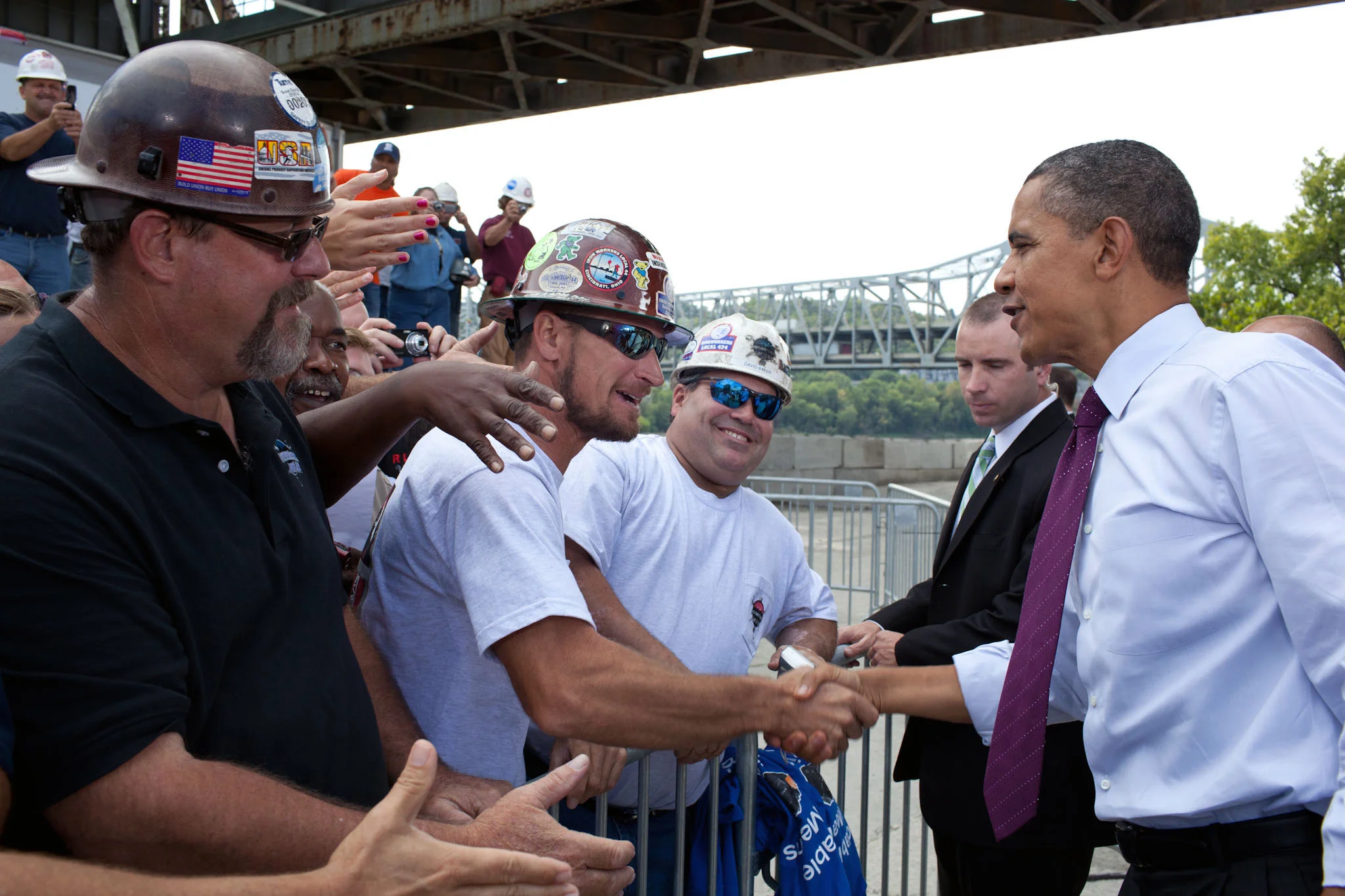
The Democrats don’t have a “white working-class problem.” They have a “working-class problem,” which progressives have been reluctant to address honestly or boldly. The fact is that Democrats have lost support with all working-class voters across the electorate, including the Rising American Electorate of minorities, unmarried women, and millennials. This decline contributed mightily to the Democrats’ losses in the states and Congress and to the election of Donald Trump.
This article originally appeared in the American Prospect on June 1st as part of The American Prospect's new series on the White Working Class and Democrats.
The road to a sustainable Democratic majority—nationally, locally, and in the states—must include much higher Democratic performance with white working-class voters (those without a four-year degree). Nearly every group in the progressive infrastructure is busy figuring out how Democrats can get back to the level of support they reached with President Obama’s 2012 victory. That is a pretty modest target, however, given the scale of Democratic losses. It underestimates the scope of the problem and, ironically, the opportunity.
The Democrats don’t have a “white working-class problem.” They have a “working-class problem,” which progressives have been reluctant to address honestly or boldly. The fact is that Democrats have lost support with all working-class voters across the electorate, including the Rising American Electorate of minorities, unmarried women, and millennials. This decline contributed mightily to the Democrats’ losses in the states and Congress and to the election of Donald Trump.
Fortunately, Democrats have the opportunity to consolidate, engage, and perform much better with all of working America. I say “opportunity” advisedly, because better performance requires Democrats to embrace dramatically bolder economic policies and to attack a political economy that works for the rich, big corporations, and the cultural elites, but not for average Americans.
Bernie Sanders’s “revolution” and attack on big money was much closer to hitting the mark than was Hillary Clinton’s message, and he won millennials and white working-class voters in the primary. It is not surprising that white working-class voters then went for Trump, and that some Sanders voters went for the Green Party in the general election, but the Democrats’ working-class problem go way beyond what Sanders broached.
What is the Democrats’ working-class problem?
Working-class Americans pulled back from Democrats in this last period of Democratic governance because of President Obama’s insistence on heralding economic progress and the bailout of the irresponsible elites, while ordinary people’s incomes crashed and they continued to struggle financially. They also pulled back because of the Democrats’ seeming embrace of multinational trade agreements that have cost American jobs. The Democrats have moved from seeking to manage and champion the nation’s growing immigrant diversity to seeming to champion immigrant rights over American citizens’. Instinctively and not surprisingly, the Democrats embraced the liberal values of America’s dynamic and best-educated metropolitan areas, seeming not to respect the values or economic stress of older voters in small-town and rural America. Finally, the Democrats also missed the economic stress and social problems in the cities themselves and in working-class suburbs.
These are big structural challenges, but we have plenty of evidence that they can be addressed and that Democrats can speak powerfully to these working-class voters about them.
The core problem is President Obama’s handling of the economy. Confronting this problem won’t make me popular. The president and the Democrats heroically rescued America and the global economy, restored the soundness of the financial system and managed the economy back to a full recovery. But incomes for most Americans fell during this period and the top 1 percent took all of the income gains of the recovery—a subject that mainstream Democrats barely mentioned and did not fight to address. The president of the United States was the main messenger for the Democrats, and his consistent economic message to the country—from one year after the crash through last year’s presidential election—was this: The recession has been transformed into a dependable recovery, our economy is creating jobs, and we are on the right track, but the Republicans drove our economy “into the ditch” and are doing everything possible to obstruct our progress. He closed the 2016 election with this appeal: We created 15 million new jobs, incomes are rising, poverty is falling, and you must get out and vote to “build on our progress.”
Closely bound up with the “progress” narrative was the bailout of the Wall Street banks with taxpayer money. Wall Street excess took the country’s economy off a cliff and Democrats rightly came to the nation’s rescue by passing the Troubled Asset Relief Program. But the bailout of the banks was, and remains, a searing event in American consciousness—and one inextricably linked to Democratic governance. While the bailout came at the urging of President Bush and his Treasury secretary, it was embraced by then-candidate Obama and passed with Democratic votes in the House and Senate. It was under President Obama that the government signed off on the executive bonuses for TARP recipients and under Obama that no executive was punished for criminal malfeasance. It should come as no surprise, then, that one year after the Housing and Economic Recovery Act’s passage, the majority of voters thought the big banks, not the middle class, were the main beneficiaries—and they were damn angry about it too.
That mix of heralding “progress” while bailing out those responsible for the crisis and the real crash in incomes for working Americans was a fatal brew for Democrats. It was evident in the double-digit drop in Obama’s approval ratings in Maine, Michigan, Minnesota, New Hampshire, and Pennsylvania in 2010. (Note this is 2010, not 2016.) His approval rating rebounded to nearly 50 percent in most of those states in 2012, but it fell sharply in 2014 in Florida, North Carolina, New Hampshire, Maine, Wisconsin, Ohio, Michigan, and Minnesota. Obama’s approval rating the year before the 2016 election hovered between 40 percent and 42 percent in Iowa, Maine, New Hampshire, and Ohio.
These are the states that figured in the well-told retreat of white working-class voters from the Democrats. But introspection among progressives—including those at the White House—failed to see the retreat of hard-pressed working-class voters in the new American majority of minorities, unmarried women, and millennials, most of whom do not have a four-year degree. While the president was calling on these base voters to come to the polls to defend the progress we’d presumably made, these voters, too, were angry about the claims of jobs and about Wall Street’s undimmed influence. They knew these jobs paid dramatically less. They saw the government rescue the big banks but do next to nothing about the home foreclosures and lost wealth in their Hispanic and black communities. That is why about 40 percent of the Rising American Electorate disapproved of how the president was doing his job in both 2010 and 2014. Every segment of this progressive base underperformed on vote and turnout in 2010, and their disengagement in 2014 gave us the lowest off-year turnout in any election since World War II and with it, another Republican wave.
The electoral consequences were particularly acute among millennials. Weighed down by student debt and the weak job market, millennials pulled back in 2010 and importantly, did not come back in 2012 when Barack Obama was on the ballot. Their vote share was down 2 points from 2008 (from 17 percent to 15 percent), and their level of support for Obama was down 3 points (from 69 percent to 66 percent). Mitt Romney won the white millennials by 7 points.
Democrats’ unified control of government under Obama and the Democratic Congress began losing working-class Americans’ support right from the outset, but progressives never collectively paused to take stock of why.
Trade is a key issue that has separated Democrats from many working-class voters. That separation grew wider with Obama’s battle for the Trans-Pacific Partnership and with Trump making his opposition to it central to his vow to represent “the forgotten Americans.”
In 2015, more than 70 percent of Democrats in the Senate (33 of 46) and 85 percent of Democrats in the House (160 of 188) had voted against giving Obama fast-track authority to negotiate the TPP. The party’s presidential candidates were strongly opposed to corporate lobbyists dominating the drafting of TPP and to major provisions that would have granted foreign corporations the right to sue for damages over U.S. consumer and environmental protections. But working-class Americans clearly associate Democrats with support for multinational trade agreements—even though they are passed with mostly Republican votes in Congress—because Democratic presidents have been their main champions over the last 25 years. NAFTA was enacted under President Bill Clinton (with my support, as I was then the president’s pollster, and over the very strong objections of my wife, Representative Rosa DeLauro). Obama made passage of TPP a consuming priority at the end of his presidency.
Support for trade and trade agreements is greatest on the West and East Coasts, among Hispanics and Asians, and most importantly, among college graduates, particularly in the big cities where Democrats govern. But the white working class, who live amid the remains of the manufacturing sector in the industrial Midwest, strongly oppose these trade agreements with increasing ferocity, particularly the men who were disproportionately employed in manufacturing.
Class and gender and TPP
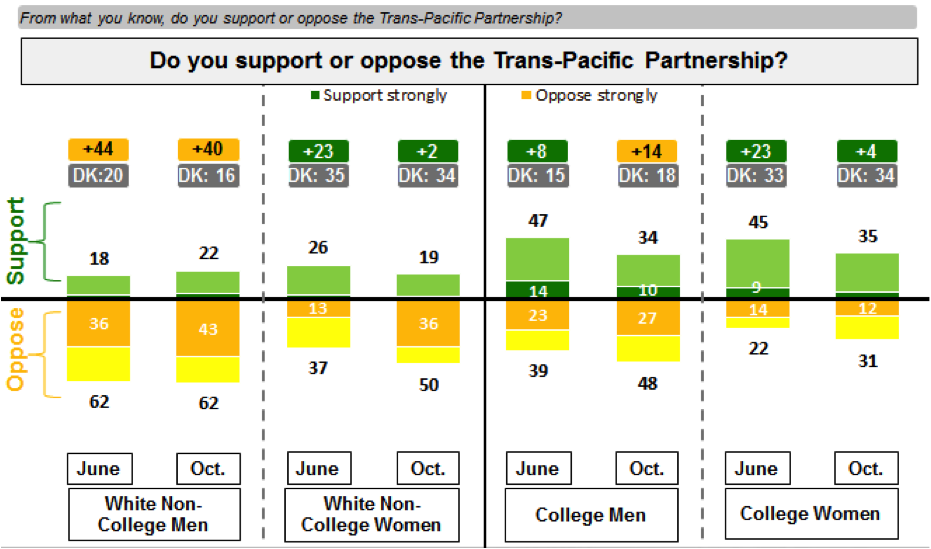
The Obama presidency produced a partisan realignment on trade, reinforcing the class and gender bases of the two parties that will disrupt the politics of both, if it hasn’t already. Before 2008, Republicans were more supportive of NAFTA than Democrats, but at the end of Obama’s presidency, GOP support for NAFTA collapsed, pushed off the cliff by Trump. Democrats, on the other hand, became more favorably disposed to NAFTA.
Partisans Flip on NAFTA
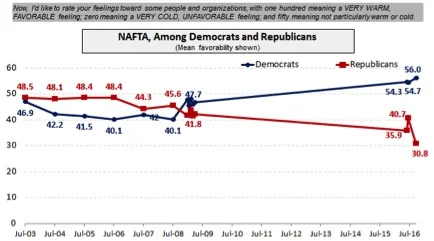
Source: Democracy Corps survey of national likely voters for Public Citizen, October 2016
With Trump centering his campaign on bringing back American jobs by withdrawing from and renegotiating trade agreements, the Republican base voters emerged as those most opposed to multinational trade agreements.
Despite Obama’s efforts, Democratic voters also shifted against trade in principle and the TPP specifically over the course of the campaign—including big shifts among millennials (a 22-point shift in margin), white unmarried women (21-point margin shift), all unmarried women (15 points), and minority voters (9 points). Yet Hillary Clinton went silent on TPP in the closing weeks of her campaign, even as Obama and his administration stumped publicly for its enactment, though there was virtually no chance a lame-duck Congress would pass it. That magnified the Democrats’ working America problem, and perhaps decisively so in the Rust Belt.
Immigration is the next critical element of the Democrats’ working-class challenge. Since 1990, the world has watched a massive increase in global migration, and, remarkably, one in five of these migrants lives in the United States. The number of immigrants in the United States doubled from 23 million to 46 million during this time, and our largest metropolitan areas are being shaped by accelerating migration and increasing numbers of foreign-born people living there. More than three million, roughly 37 percent, of New York City residents were born outside of the United States; 60 percent of Miami’s residents and almost 30 percent of Houston’s residents are foreign-born.
Despite Trump’s ascendance, America remains one of the few places in the world that views immigration as positive, but Americans’ reactions have a strong class and race component that reinforce the conclusion that there is a working-class challenge cutting across partisan lines. In Democracy Corps’ election night survey, it was white college-educated women who embraced immigration most strongly, and not surprisingly, white working-class men who were most cautious. But do not assume that African Americans do not share some of those concerns; many in our focus groups raise anxieties about competition from new immigrants.
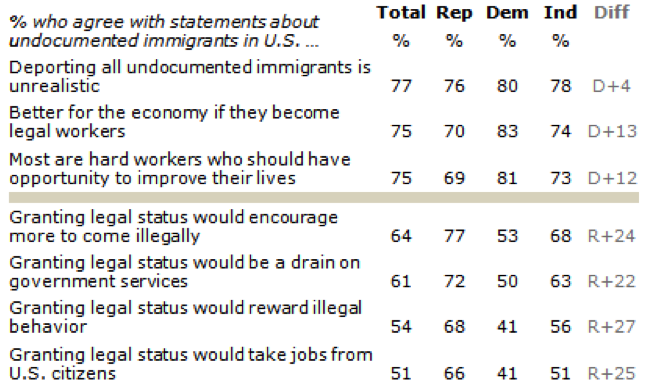
But reactions to legalization for the undocumented reveal some of the emotional and economic dynamics at play. Americans are fairly positive about the economic effects of legalization and see many of these immigrants as hard-working, but they do worry about the costs. More than 60 percent believe granting legal status would lead to greater competition for public services and more than half believe it would take jobs from American citizens. Those numbers are not driven entirely by Republicans. Indeed, 41 percent of Democrats think those immigrants would “take jobs from U.S. citizens,” and more important, half of Democrats believe granting legal status “would be a drain on government services.”
Perceived costs of legalization
Obama, who led the battle for immigration reform, was fairly trusted on this issue, as he always began by defining “real reform.” It meant “stronger border security,” and his administration did in fact put “more boots on the Southern border than at any time in our history.” “Real reform” also meant “establishing a responsible pathway to earned citizenship” that included “paying taxes and a meaningful penalty” and “going to the back of the line behind the folks trying to come here legally.”
Pro-immigration advocates won majority support for comprehensive immigration reform only after the public became confident that leaders wanted to manage immigration and that they took borders and citizenship seriously. The reform that passed the U.S. Senate increased enforcement at the border, introduced new technology to ensure lawful employment, expelled those with criminal records, and allowed a path to citizenship for those who paid a fine and back taxes and learned English. That combination allowed progressives to proudly advocate a new law that would greatly expand the number of legal immigrants and make America more culturally and economically dynamic.
By the time Hillary Clinton was running in 2016, however, the path to citizenship moved to the center of her offer, as did concern for immigrant rights in the face of Trump’s promised Muslim ban and Mexican border wall.
A month into Trump’s presidency, Democracy Corps and the Roosevelt Institute conducted focus groups with white working-class Trump voters who had previously supported Obama in Macomb County, Michigan. It was clear how central concerns about immigration, borders, foreignness, and Islam were to their receptivity to his call to take back America. Many thought Clinton, on the other hand, wanted “open borders.”
I am confident Democrats will once again lead a multicultural America in the same way America has forged unity from such diversity in the past. We build on a unique framework for immigration and a unique history. Even this ugly interlude will not keep America from its exceptional path.
The final dynamic distancing Democrats from working-class America is the party’s alignment with the economically and culturally ascendant in America’s metropolitan centers, where Democrats win office and govern. As Clinton’s winning popular vote margin grew to nearly three million, concentrated in an ever-smaller number of urban counties, the Brookings Institution revealed that fewer than 500 Clinton-won counties produced two-thirds of the nation’s GDP in 2015.
Perhaps that is why President Obama and Secretary Clinton sounded so satisfied with the state of America and its future. In nearly every speech for most of his presidency, including in his 2014 State of the Union address, Obama rightly declared that America “is better-positioned for the 21st century than any other nation on Earth.” When he and Clinton closed the 2016 campaign in Philadelphia, Detroit, Miami, Chicago, Raleigh, Cleveland, and Columbus with their upbeat take on America’s future, they symbolically aligned the Democrats nationally with the economically and ascendant cities—and they barely noticed anything amiss in smaller cities and towns and rural America.
They were also aligning the national Democrats with a liberal narrative and moral frame that values equality, equal rights, and fairness. They are more empathetic and worry more about harm to the vulnerable. They are more open to diversity and celebrate differences and outside cultures. They value a kind of individualism that emphasizes personal autonomy, self-expression, and sexual freedom for men and women. They welcome the emerging pluralism of family types and reject the traditional family and gender roles. Education is the path to individual fulfillment and opportunity, and science and technology are the keys to learning discoverable truths. They consciously do not turn to traditional authority for moral absolutes, and they devalue those who depend on faith-based conclusions.
Those who hold to a conservative moral frame, by contrast, accept faith-based moral absolutes and respect traditional authority. They honor an individualism that is grounded in personal responsibility, industriousness, strong work ethic, self-reliance, self-restraint, and self-discipline, which guard against idleness and dependence. They honor the traditional family and the male breadwinner role. They value patriotism, love of country, and those who defend it from our enemies, and they believe American citizens come first.
What the national Democrats’ embrace of the liberal moral frame and America’s economic ascendance misses is not just the plight of nonmetropolitan America, but also the reality on the ground in the big cities, which are ground zero for our country’s greatest challenges. Any Democrat running for mayor in New York, Chicago, or Los Angeles knows this, which is why Mayor Bill de Blasio’s critique of “two New Yorks” was so resonant. It is in these cities where large numbers of residents are struggling economically, with low-wage jobs and sky-high costs of living, where poverty and segregation stubbornly persist, where millions of children are raised by single parents, and where inequality is most stark. At the same time, the increasingly diverse ethnic and racial mix in the cities is full of working-class communities where both liberal and conservative moral frames matter. For example, like the more conservative working-class whites, African American women place a high premium on faith in God and the need to put American citizens before immigrants. That is why the simple embrace of metropolitan America’s liberal values and economic elite hurt Democrats with working-class voters in both the big cities and in rural America.
Fixing the Democrats’ working-class problem
The rift between Democrats and working-class Americans was painfully widened by how Democrats governed and campaigned nationally. The party was not up to the great challenge of leading an America that is more culturally diverse and racially conflicted, more urban and younger, more economically and socially unequal, and more corrupt. All of those challenges, however, are also a call to action.
After the 2014 debacle and in advance of the 2016 presidential cycle, the Women’s Voices Women’s Vote Action Fund, with which Democracy Corps partners, produced a frank report on disappointing results in our base. They highlighted the unmarried women whose vote for Democrats dropped 7 points from 2012, and the fact that Democrats lost white unmarried women by 2 points. That is when we made the connection between white unmarried women and the white working-class women who are now a majority of the white working class. Both groups see only a precarious path to the middle class.
Both believe jobs don’t pay enough to live on and that the middle class pays a lot of taxes. Both groups, more than other voters in the Rising American Electorate (RAE), expressed concern about welfare-spending and getting control of the border. When we tested a bold Democratic economic agenda against the Republican agenda, white unmarried women embraced the Democratic offer with great enthusiasm, and this agenda trailed the Republican offer by only 8 points among all white working-class women. The results were so promising, we proposed at the outset of the 2016 cycle that progressives adopt an “RAE+” strategy to reach the working class more broadly.
Given how disastrously Clinton performed with white working-class voters in the end, it is important to recall with data that she was poised to over-perform with the white working-class women compared with Obama in 2012, when Mitt Romney won white working-class women by 17 points. During the presidential debates, Clinton closed Trump’s margin with white working-class women to just 4 points in NBC/Wall Street Journal’s national polling—and those voters did not break away from her until the last week, after Clinton went silent on the economy and change. These white working-class women, who form a majority of today’s white working class, were open to voting for Clinton, perhaps in historic numbers.
White working-class 2016 presidential vote
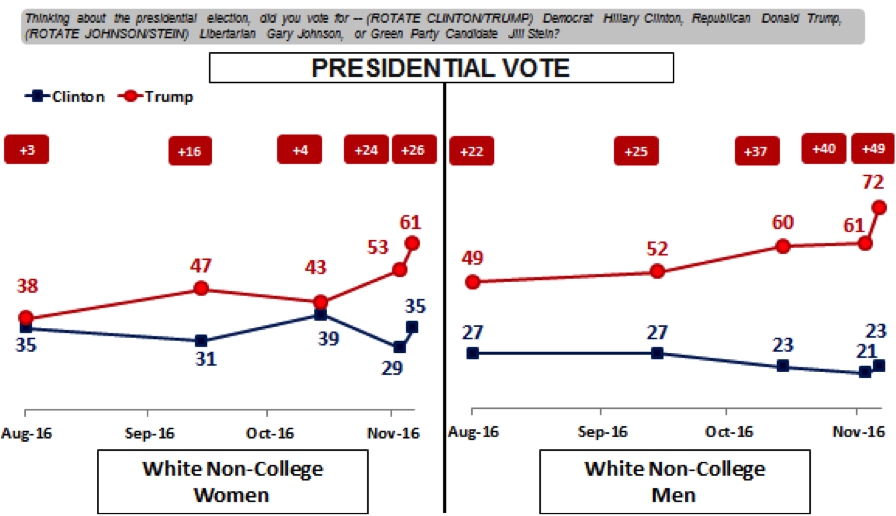
Source: NBC/WSJ national likely vote surveys, 2016
Not surprisingly, white working-class women form a big portion (40 percent) of the independents and Democrats who voted for Trump in the end. While Republican Trump voters think of themselves as middle-class, and two-thirds say they would have no problem handling an unexpected $500 expense, these non-GOP Trump voters think of themselves as working-class and would struggle to handle the sudden expense. They are also, in contrast to the Trump Republicans, pro-union.
But, in what may border on campaign malpractice, the Clinton campaign chose in the closing battle to ignore the economic stress not just of the working-class women who were still in play, but also of those within the Democrats’ own base, particularly among the minorities, millennials, and unmarried women. It likely diminished turnout in the cities and Clinton’s vote across the base.
Obama’s final campaign speeches spoke of an economy that moved from recession to recovery and created 15 million jobs with rising incomes and reduced poverty. But if you look at people’s view of the economy on the night of the election, three in five scorned that rosy economic outlook—led by nearly every group in the Democrats’ base. “Jobs don’t pay enough to live on and it is a struggle to save anything,” said 70 percent of minorities and 65 percent of unmarried women in our post-election survey. A majority of unmarried women said they could not handle an unexpected $500 expense, putting them most on the edge. That is the heart of the Rising American Electorate, and their judgment on the economy was very close to white working-class women’s.
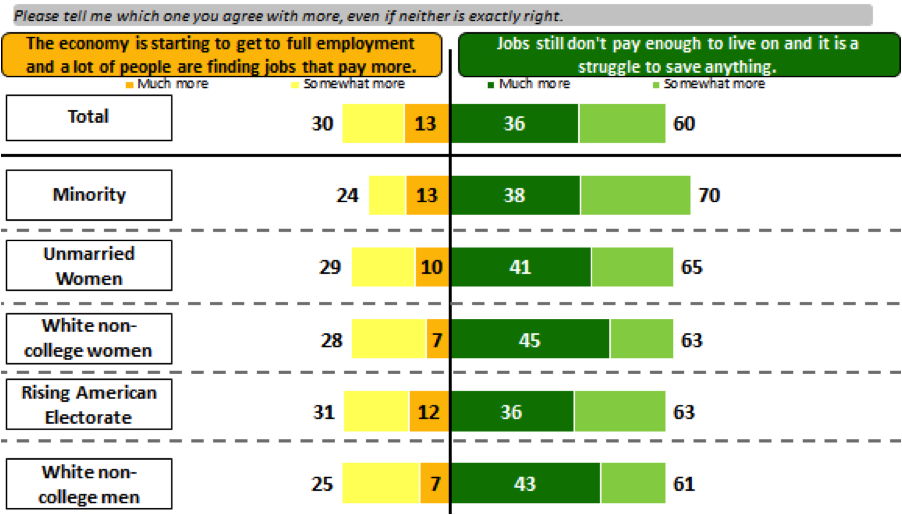
The failure to see that the problems of working America run right through the new American majority cost the campaign a chance to produce a very different result in this election.
As I have written in The Guardian and Democracy Journal, Clinton’s strong performance in the debates produced big gains for her regarding which candidate was better suited to handle the economy and taxes, and to stand up for the middle class and against special interests. After the debates, she was near parity with Trump on handling the economy—closing an 11-point pre-convention gap.
Democracy Corps’ national survey conducted after the debates and shared with the Clinton campaign showed that more attacks on Trump’s temperament and his treatment of people and women barely moved voters. In contrast, a compelling economic message demanding “an economy for everyone, not just the rich and well-connected,” attacking trickle-down tax cuts “for the richest and special breaks for corporations,” and promising an agenda to “rebuild the middle class” moved unmarried women (including white unmarried women), millennials, and white working-class women.
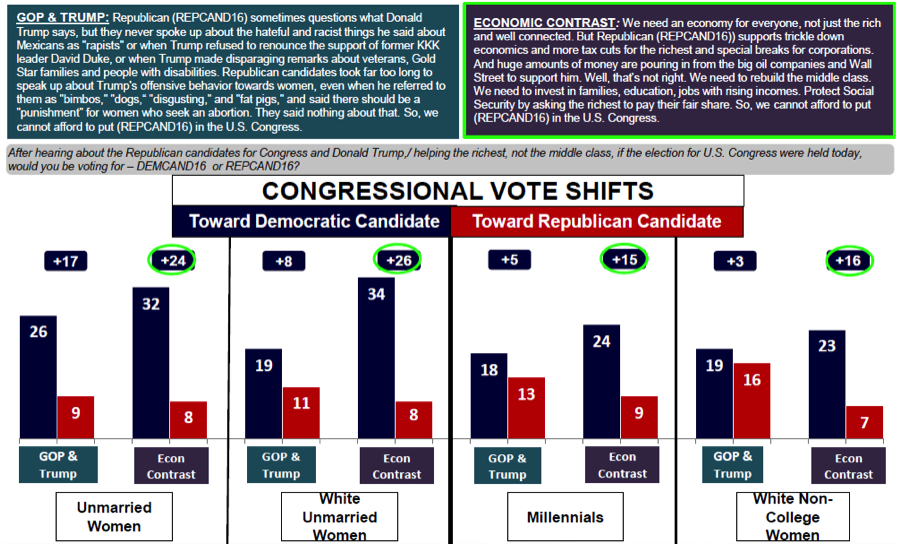
This experiment showed—retrospectively, alas—that Democrats can reach working-class Americans both in our base and well into the swing electorate, including the white working class. It is time to make that challenge task number one.

Immigration and the Super bowl
A large majority of Americans believe that immigration enriches the country as opposed to causing problems. Please see these Super Bowl commercials as a window into what Americans really believe and hold dear.
Immigration and the Super Bowl
Donald Trump won the US presidency on an anti-immigration platform and moved ahead with a 'Muslim ban' and the border wall. But advertisers at the Super Bowl understood the real America where a large majority believes immigrants strengthen our country. Even white working class men are divided on the issue.
They might have been brave, but I would guess they know their market, their own employees, America's identity and the broad comfort with diversity, particularly among millennials and dynamic cities. They may be betting on the future.
Class and Immigration
Parties of the Left, Wake Up!
Center-left parties in America and Europe are struggling. They are struggling for three reasons: First, they have failed to offer a credible response to the period of prolonged income stagnation and growing inequality; second, they have become part of the political-business-elite accommodation that the public views as corrupt; and third, they have been indifferent to the disruptive effects of globalization and loath to show immigration needs to be controlled.
Democracy Journal JAN. 31, 2017
Center-left parties in America and Europe are struggling. They are struggling for three reasons: First, they have failed to offer a credible response to the period of prolonged income stagnation and growing inequality; second, they have become part of the political-business-elite accommodation that the public views as corrupt; and third, they have been indifferent to the disruptive effects of globalization and loath to show immigration needs to be controlled.
Donald Trump’s improbable and tragic victory has now shown painfully and unnecessarily how important are those factors in the United States too. It would have been better had we been spared this American experiment, but we can at least learn from it, and quickly.
Hillary Clinton lost steam in the closing weeks and days because her campaign chose not to contest the economy or the undue influence of the few over government. They chose not to attack Trump for cheating workers and small contractors and for using cheap Chinese steel and undocumented immigrants. They chose not to contrast Trump’s massive trickle down tax cuts for billionaires with Clinton’s tax cuts for the middle class. They decided not to tantalize voters with her promise of bold reforms to make the economy work for all, not just those at the top.
WikiLeaks published some of my emails to the campaign’s chair, and he invited me after the FBI’s late interjection to share my findings on the power of closing on the economy, but Clinton’s top manager and advisors pushed back, saying, “We can’t win the economic argument.”
Instead, she appealed for unity over division, hope over hate, and experience over bad temperament. She promised an era of unrivaled opportunity for all groups, and to build on Barack Obama’s economic progress. After all, “America is already great.”
The campaign came to that assessment despite Clinton achieving her biggest margins in the race after uniting with Bernie Sanders and Elizabeth Warren and embracing their case for economic change; after her convention speech, when she called for a fair, inclusive economy; and after the debates, wherein she articulated her bold economic plans, prosecuted Trump mercilessly for his “Trumped-up trickle down” tax cuts for billionaires and repeatedly promised to raise taxes on the rich, because they’ve reaped all the gains and “that’s where the money is.”
Secretary Clinton invited me to weigh in on her economic speeches and message, and the result was most evident in the debates. After they aired, just weeks before Election Day, Clinton achieved parity with Trump on who could best handle the economy, the number one issue to be decided on Election Day, according to exit polling, and the top concern for 60 percent of her own voters. Clinton voters, even more than Trump’s, were angry at corporate abuse. Yet Clinton went silent on the economy, corporate irresponsibility, and undue special interest influence.
As a result of that choice, she lost the struggling white working class, particularly the women who broke for Trump at the end. She also lost ground with the progressive base voters, who disappointed on turnout and vote share. Millennials, Sanders voters, single women, and minorities were struggling financially, and they were the voters most determined to disrupt the nexus of Wall Street and Washington. Secretary Clinton was acutely conscious of the pain so many families were experiencing, but, she told me, she couldn’t be seen to be critical of President Obama’s economy in any way.
Iadmire what Obama achieved as President, but he, like so many other center-left leaders who led their countries’ passage through the financial crisis, have been nearly silent on the new economic reality of long-term income stagnation, jobs that don’t pay enough to live on, and the richest 1 percent taking virtually all the new income and wealth gains. Few have championed plausible plans bold enough to produce a more broadly shared prosperity.
Obama faced an economy in free fall and acted boldly to keep it from heading into a depression. The economic project of his whole presidency, accordingly, was getting the economy to a full recovery. That started with restoring the financial health of the big banks. The long-term stagnation of wages and inequality was not part of that project. Obama also declined to be an educative President who spent time and capital explaining his initiatives, even the economic policies and the Affordable Care Act that had the middle class as the main beneficiary. Obama believed that the progress and positive changes on the ground—the “facts”—would ultimately become evident to the people. He would thereby be vindicated and his opponents rejected.
As a result, his economic recovery effort came to be seen as “bailouts.” One year after the passage of the economic recovery program, most thought the big banks, not the middle class, were the main beneficiaries of Obama and the Democrats’ heroic efforts. TARP remains a searing event in the consciousness of a citizenry who think the elites, joined by Obama, rushed to bail out the irresponsible and protect their executive bonuses while doing nothing about home foreclosures or the lost wealth that hit the Hispanic and black communities particularly hard.
Yet this was the President’s message from the beginning, pursued also in the midterm elections of 2010 and 2014 and the general election of 2016: The country is making progress and the economy is recovering and you should punish the Republicans who want us to fail. In his final weekend speech before the 2010 election, he scorned the Republicans who had driven our economy “into a ditch” and were now doing everything possible to impede us, and argued that the car was “pointing in the right direction.”
The President used this refrain again in 2014, a second off-year shellacking, and in his closing weekend appeal in 2016: “We’ve seen America turn recession into recovery” and have created 15.5 million new jobs. Pointedly, he said, “Incomes are rising. Poverty is falling.” So get out and vote because “we now have the chance to elect a forty-fifth president who will build on our progress.”
Obama closed his presidency uncharacteristcially, campaigning publicly and lobbying Congress intently to win passage of the Trans-Pacific Partnership, a proposed trade deal with 12 Pacific Rim countries, encompassing 40 percent of the global economy. He argued that it would grow the U.S. economy, raise labor and environmental standards, and block China’s strategic advance. He won the acclaim of editorial writers, but TPP lost public support as opponents argued that it was actually shaped in secret by hundreds of industry lobbyists and would allow foreign corporations to sue our government and overturn consumer protections. Finally, they argued that it would cost U.S. jobs and push down wages; that was the final straw for many working-class voters who opposed the agreement intensely. This was at the heart of Trump’s campaign in the Rust Belt states and subsequent attacks on Clinton.
Voters already viewed Obama’s economic commentary incredulously and his approval ratings fell dramatically in 2010 in Maine, New Hampshire, Pennsylvania, Iowa, Minnesota, and Wisconsin and in 2014 in Iowa, Michigan, North Carolina, Ohio and Pennsylvania. On the eve of the 2016 general election, Obama’s approval hovered near 40 percent in many of these states.
The discontent was also evident very early on within the progressive base. In both the 2010 and 2014 midterm election years, 40 percent of the new American majority of minorities, unmarried women, and millennial voters disapproved of how the President was handling his job, and many chose not to vote. These were the voters most burdened by new lower-paying jobs, foreclosures, lost house value, and student debt.
As a result, Obama struggled with working-class voters and millennials in his own re-election. In 2012, few commentators and strategists commented on Obama’s millennial vote, which had dropped from 69 to 60 percent, while Romney carried white millennials by seven points. Perhaps millennials were the canary in the coal mine.
And while the Obama Administration was scrupulous in avoiding personal scandal and self-dealing, voters quickly concluded our government favored Wall Street over Main Street, with the way smoothed, they assumed, by lobbyists and big donors. Voters grew ever more skeptical about the massive growth of campaign spending, lobbying, SuperPACs, and dark, secret contributions during Obama’s period in office. Yet the Democratic Administration never prioritized reforming the role of money in politics. Indeed, Obama raised billions outside the system of public financing.
Bernie Sanders, by contrast, declared that he prioritized getting money out of politics over any other policy, since breaking that corrupt bond would liberate government and allow it to work for the middle and working classes. He attacked Hillary Clinton’s SuperPAC and Wall Street contributions and said, “You’re not going to have a government that represents all of us, so long as you have candidates like Secretary Clinton being dependent on big money interests.” Senator Sanders won 72 percent of the millennial vote in the primary.
Many middle Americans believed they were seeing the real Obama when he told his big donors that white workers “cling to guns or religion or antipathy to people who aren’t like them or anti-immigrant sentiment or anti-trade sentiment as a way to explain their frustrations” in tough economic times; or the real Mitt Romney when he described the 47 percent who “are dependent upon government, who believe that they are victims, who believe the government has a responsibility to care for them, who believe that they are entitled to health care, to food, to housing, to you-name-it”; or the real Hillary Clinton when she described half of Trump’s voters as belonging in “the basket of deplorables.” Together, they offer a powerful imagery of our elected leaders from both parties hanging out and catering to the economic and cultural elites, while analyzing and patronizing America’s working people.
Those elites and the great majority of Americans with a four-year college degree are comfortable with globalization, growing international trade, and immigration. They do not fully understand that most working people of all races believe government and elected leaders have an obligation to control immigration. Six-in-ten voters believe immigrants strengthen our country, but they also think borders should be real and citizens should matter more than non-citizens. They worry somewhat about competition for jobs, but even more about access to schools, housing, and health care, all desperately short of resources.
President Obama and Democrats gained majority support in the country for comprehensive immigration reform because their plan involved increased enforcement on the border and in workplaces along with giving the law-abiding, taxpaying undocumented a path to citizenship after paying a fine and learning English. This reform allowed the Administration to manage immigration and build a framework for increasing entry numbers in the future, but they also showed that they were serious about border control and citizenship. President Obama did not allow undocumented immigrants to gain subsidies under Obamacare, and he deported more undocumented immigrants than any other President. He took a lot of heat from activists, but the Democratic Party was probably the only center-left party in the advanced world trusted to address immigration, and that is probably still true today.
During the campaign, Hillary Clinton differed with that approach. She promised to end deportations for all but violent criminals and terrorists and declared, “I’m introducing comprehensive immigration reform within the first 100 days with the path to citizenship.” Her focus was not on managing immigration, but on enforcing immigration laws “humanely” and respecting the rights of immigrants. She paid a price for that, I believe. The biggest hope of the independents and Democrats who voted for Trump was that “he will get immigration under control and deport those here illegally.”
Voters made clear they want an economy, society, and government that works for them. Obama left office with a rising approval rating in the same range as Ronald Reagan, with an economy nearing full employment, and real wages climbing up. Still, half of voters in the last election said the economy was the top priority in their voting choice. These voters were sending a very clear message: They want more than just a recovery. Trump mercilessly exploited that; he won because he offered change and American jobs, vowed to take on disloyal American companies and their corrupt deals with the Washington elite on immigration and trade; Clinton, in the end, engaged on none of them.
Before America gave us Donald Trump, Great Britain, for many of the same reasons, gave us the Conservative Party’s surprise victory in 2015 and, of course, Brexit.
But Hillary Clinton can at least be satisfied with the fact that she won the popular vote by almost 3 million votes, a 2.1-point margin over Trump. The British Labour Party, on the other hand, is struggling today to reach 30 percent of the vote, and the Conservatives hold a double-digit lead.
I myself once worked as a pollster and strategic advisor to Tony Blair when he and Gordon Brown helped create New Labour. They were tough on crime and on its causes and wanted to reward hard work; they showed independence from trade unions so they could, instead, govern for all. Labour attacked Conservative boom-and-bust economic incompetence. They promised limited spending and no rise in income taxes so that voters could trust them to invest, renew, and reform the public services, particularly the National Health Service and schools. They were reelected under the banner, “Schools and Hospitals First!” They introduced a minimum wage and EU work guarantees and aggressively used tax credits to make sure most families saw incomes rise and poverty fall throughout the government’s first decade in power. Labour won the working class and middle class alike, including landslide majorities in two general elections and a respectable majority in the third.
But Blair’s New Labour project did not have much to offer working-class voters. Consequently, the election of 1997 saw a 6.3 point drop in turnout, reaching historic lows, while 2001 saw a further drop of 12 points, the lowest since 1918. The turnout crash was greatest in older industrial Labour seats, among unskilled manual workers and younger blue-collar workers.
I tried to focus the prime minister and Labour party’s attention on that disengagement, but Blair was much more interested in Labour winning comparable levels of support among all classes, and he resisted talking about “hardworking families,” a two-tier Britain, or attacking the Tories for only caring about the few. His New Labour project was more about community, unity, and One Nation, ideas that seemed disconnected from the emerging economic challenges in Britain.
Blair was right to weaken the ability of trade union leaders to dictate the party’s policies and leaders and thus, make Labour electable again, but he also moved toward a new level of accommodation with business and the City, the most dynamic part of the economy. That accommodation, however, also included visible association with very rich donors who helped fund the party and campaigns. And when the expenses scandal rocked the reputation of many MPs, Labour politicians struggled, more than ever, not to look like they were just in it for the money.
But at least, at that time, Blair’s government was associated with stable growth and a broadly shared prosperity. That was not the case when Gordon Brown lost his election in 2010. Incomes had stagnated for the four years before the financial crash. Labour policies were not producing a rising prosperity for those in the middle, yet the party continued to argue for its economic competence and successes.
At the same time, Labour barely spoke above a whisper about immigration, even though immigration from the Commonwealth and expanding EU rose dramatically under Blair and Brown’s watch. The Labour government scarcely acknowledged that asylum seekers and immigrants affected the availability of council housing and increased pressure on the schools and NHS. Blair was not willing to press his party for reform, and Brown viewed these working-class frustrations as racist, most notoriously when a TV microphone that he thought had been switched off caught him calling Rochdale pensioner Gillian Duffy “just a sort of bigoted woman” after she had expressed concerns to him about Eastern European immigration at a campaign event.
Indeed, it could be said that the biggest doubt about the Labour government when it lost power was its failure to get immigration under control. Ed Miliband as Labour’s new leader resisted speaking about the issue or advocating for greater control until the general election neared.
With Labour’s credibility shredded on spending and debt, the party barely challenged the economic policies of the Conservative-led coalition government under David Cameron. It claimed that the Tories were cutting spending “too far, too fast,” but did not challenge deficit reduction as the first task of economic policy. And it did not make the case for long-term investment, growth, and shared prosperity.
Labour’s manifesto for the 2015 general election promised that every policy would be paid for, that the party would “cut the deficit every year,” accelerate the increase of the minimum wage, end zero-hour contracts, guarantee apprenticeships for all those coming out of high school, reduce university fees, freeze energy bills, raise the top tax rate from 45 to 50 percent, but not VAT or income tax, and launch an “all-out assault” on tax avoidance. It felt like fingers in a dike rather than an economic offer to produce rising incomes again.
Over the last two decades, Labour lost votes to abstention, to the Tories, and to the anti-Europe and anti-immigration UK Independence Party.
Ed Miliband reached his highest level of support when he challenged Rupert Murdoch and the tabloids that had illegally hacked phones to produce sensational stories. It seemed then that he was willing to break with the elite “establishment” and call out the cozy arrangement of business and government. He also improved his support and raised Labour’s poll numbers when he committed to freeze energy bills, a policy dismissed derisively by the big utility companies. But those gains were episodic and insufficient for the working class, and Labour lost badly in the general election; it later lost many Labour constituencies to Brexit.
Well, the center-left parties now all across Europe are struggling and losing ground to anti-establishment and anti-immigrant parties. The U.K. Labour Party is even more marginalized under its current leader, Jeremy Corbyn, who questions whether Britain is obligated to respond militarily to a Russian attack on a NATO member and speculates publicly about a nationwide pay cap to address inequality. The party is deeply fractured on immigration and on the free movement of labor from the EU.
In Austria, the anti-immigrant and anti-Islamic Freedom Party candidate Norbert Hofer won 46 percent of the vote in the election for president.
Italian Prime Minister Matteo Renzi resigned after the “No” campaign won almost 60 percent of the vote in the referendum of constitutional reforms that Renzi was pushing. Although this defeat could be explained in a number of ways, Italy is a country where disposable income declined since Renzi formed his Democratic Party government and where 60 percent of the public believes immigration and diversity are a threat to the country—one of the highest levels in Europe.
Donald Trump’s win has given heart to the anti-establishment and anti-immigration parties everywhere, but it also taught us a lot. To start, center-left parties must:
- Put working-class economics front and center.
- See the country’s challenges through the lives of working people and be skeptical of conventional wisdom emanating from the elites in metropolitan center.
- Acknowledge frontally that immigration needs to be better controlled and people are right to want a framework that includes real borders, new migrants contributing through taxes and learning the country’s language, and a framework where citizens receive greater benefits than non-citizens.
- Take on the elite, big money special interests that play too big a role and are the prime drivers of economic and social inequality.
- Offer much bigger economic vision and policies.
Obviously, many of these will be hard to do. One cannot simply pull economic policies bold enough to shift the distribution of income and wealth off the shelf. Our leaders live and breathe the air and culture of our metropolitan centers. Business donors are very real. And accepting the legitimacy of immigration worries will be most controversial and challenging for progressives who embrace multiculturalism and must also fight Donald Trump, Nigel Farage, and Marine Le Pen’s outrageous and racist polices.
The left can still regain the momentum they need to push through bold reforms if they are honest about the past and bold about the future.