Why Are ‘Ten Million Jobs’ So Incendiary?
Middle-class workers who haven’t seen higher wages in decades don’t want to hear about a booming economy.
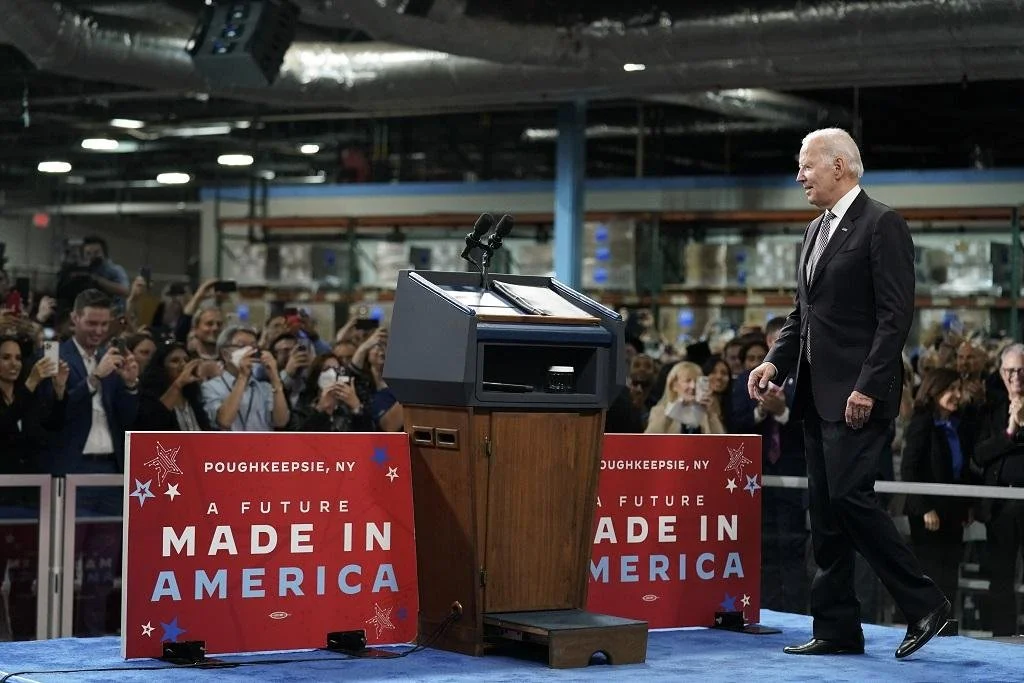
President Biden spoke last Thursday at IBM in Poughkeepsie, New York, praising the companies that are investing in America, “because they see we’re coming back.” He doubled down on his view that Democrats are presiding over a hell of an economy. “Since I came to office, our economy has created 10 million jobs, 668,000 manufacturing jobs.” He reminded listeners that last month, he heralded the building of a semiconductor factory outside of “Columbus, Ohio, where Intel is investing $20 billion, 10,000 good paying jobs.”
Biden also reminded voters he’s gotten the unemployment rate lower than President Trump. “It’s more jobs created in the first term of a President than any time in American history.”
This rhetoric is sure to create new barriers for Democrats to get over, when their campaigns are contesting who is better at addressing the top issue in the election, the daunting cost of living.
Why are such statements about “ten million jobs” a red flag for working people?
The full article can be read at The American Prospect.
Will Democratic Leaders Get Their Message Right?
Our polling suggests winning themes.
Democrats have the momentum in the 2022 midterm election, our new Democracy Corps survey shows. Democrats have pulled into a 3-point lead with registered voters and 2 points in the likely electorate. Amazingly, Democratic partisans are no longer less enthusiastic and engaged. Democrats are slightly more consolidated, and Republican fractures are growing. Cheney conservatives will give Democrats a few more points, as she now says is her goal.
Yet much of this momentum seems accidental and ahistorical, and the Democrats’ lead is fragile and at risk. This also means Democrats, progressives, and commentators could take the wrong lessons from 2022.
Let’s take a deeper look.
This survey was conducted with a large sample of 2,770 from an online panel. This survey included oversamples that produced a survey with 1,000 whites, 632 African Americans (or Blacks), over 600 Hispanics, and 530 Asians. (Wherever possible, I am using the terms people use for themselves.)
Remember, this weighting methodology maintains the non-college proportions from 2020, matches feelings toward the NRA and pro-life groups to phone polls to offset the social-liberal bias of web panels, and matches the recalled Trump vote to 2020. This poll, like my others, still shows Trump as slightly less unpopular than Biden.
Democrats have gained momentum with the launch of the January 6th hearings that began in June. But after the panel’s hearings, they saw a Democratic Congress and Biden Justice Department holding Donald Trump accountable for the January 6th insurrection. In July, the Supreme Court overturned Roe v. Wade; Republican-controlled states reduced the number of weeks for legal abortion and removed exceptions for rape and incest. Then, Sen. Graham committed to bar abortion nationally.
Democrats began in a hole when the Progressive Caucus and Sen. Joe Manchin said “no” in negotiations, weakening President Biden. But then that all changed just before the August recess as Congress passed the PACT Act to aid burn-pit veterans, the CHIPS and Science Act to regain U.S. leadership and domestic manufacturing in key industries, and then to everyone’s surprise, the Inflation Reduction Act.
All of this changed the perceptions since July of which party is better on key issues. And these changes are not at all small. The biggest gains for Democrats were on “encouraging extremists,” “doing what they say” and “getting things done,” “the economy,” and most important, “helping with the cost of living.” The last is, by far, the most pressing issue for the country.
Democrats have narrowed the gap on the economy but still trail Republicans by 8 points. Staying there is fatal. People are on the edge financially, and they are paying a lot of attention to what is happening in Washington. The parties are now at parity on who is better on the cost of living, including a big change in who is “much better”—one of the most important changes since July.
The full article can be read at The American Prospect.

The newest trade framework will face a very wary public
Nearly half of the global economy’s rules are up for grabs this week as the U.S. trade representative and secretary of Commerce convene trade ministers from 13 Pacific Rim nations in Los Angeles. Their task is to launch negotiations for a proposed Indo-Pacific Economic Framework (IPEF) trade deal.
I want President Biden’s team to succeed in creating the “worker-centered” agreements the president pledged. To win a very wary public’s support for any Indo-Pacific deal, negotiators need to go in recognizing some major potential pitfalls.
Across the political spectrum, the public is united in thinking trade agreements emerge from a corrupt, secretive process. They think America’s billionaires and corporate monopolies, U.S. oil giants, pharmaceutical, Big Tech and telecommunications corporations, along with their lobbyists — write the rules.
My organization, Democracy Corps, conducted focus groups in July with service sector workers in Philadelphia, Republican men in Houston and Fort Worth and college-educated voters in Seattle. When asked about “trade agreements,” I realized they looked at it through a pretty distrustful first filter: Who has the power to shape them?
The full article can be read at The Hill.
The Politics of the Child Tax Credit
Voters see it as a strong Democratic accomplishment, and a key Republican vulnerability.
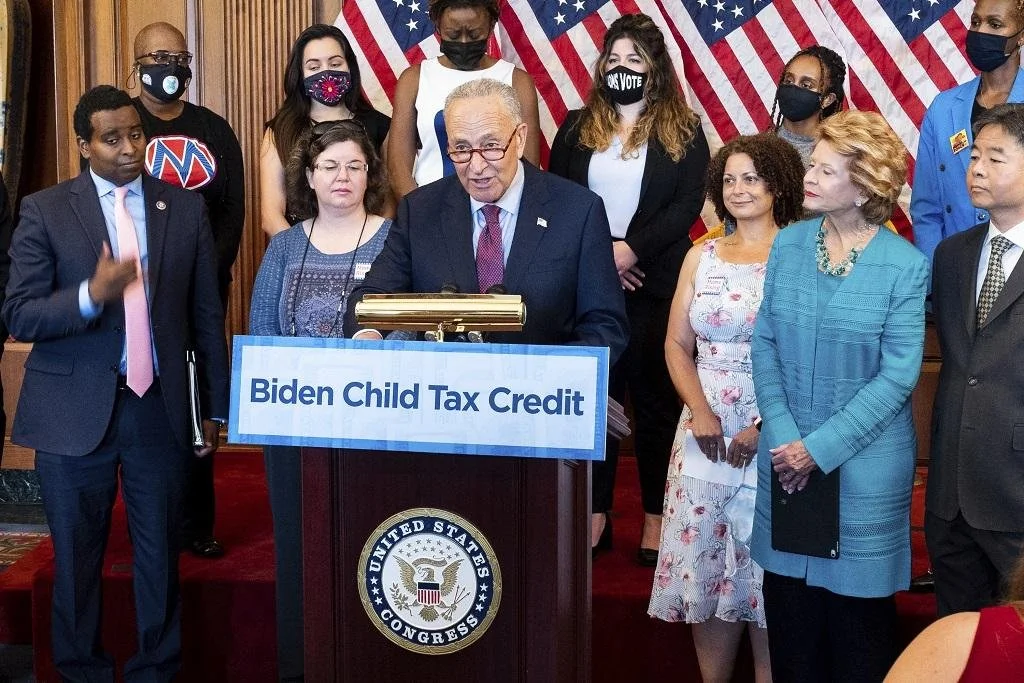
In the American Rescue Plan, passed at the outset of the Biden administration, Congress greatly expanded the Child Tax Credit (CTC) to virtually all families with children, and paid it out monthly for the first time. Starting in July 2021, the IRS sent families payments—$300 for each child under 6 years of age and $250 for children 6 to 17 years. The credit was made fully refundable and offered to families with the lowest incomes for the first time. More than 90 percent of all children were eligible for the credit. (Full disclosure, my wife Rosa DeLauro was a co-author of the policy.)
While only in place for a year, the results of the expanded Child Tax Credit were—without understatement—transformative.
Harvard economist Jason Furman wrote, “The Biden plan is the most impressive and ambitious child poverty plan ever in the United States. This would not just help in the short run but have long-run mobility benefits as well.”
H. Luke Shaefer and Kathryn J. Edin, co-authors of $2.00 a Day: Living on Almost Nothing in America, wrote, “The expanded child tax credit could effectively eliminate the kind of $2-a-day poverty that motivated our book … We have the ability to wipe away the most extreme forms of child poverty with a simple policy.”
Academic studies found that in just its one year of operation, the expanded CTC was delivered to 36 million households and cut child poverty by over 40 percent, with 3.7 million kids lifted out of poverty. The number of children without enough to eat fell by three million. And after it expired, 2.1 million children in Black, Hispanic, and Indigenous communities fell into poverty.
The additional funding for poor families sustained families and supported work. Low-income recipients spent more than 90 percent of the added money for food, utilities, clothing, diapers, and education. Many used the monthly credit to cover child care costs so they could go back to work. When the monthly payment stopped, the number of unemployed went up because these families could not afford child care.
The worry of conservative skeptics that the payment would be “welfare” and lead to people declining employment has not been borne out.
The expanded Child Tax Credit is expensive, but it is an investment. Economists have found that taxpayers get 84 cents back for every dollar spent in children being healthier with decreased health care costs, less costs for child protection and foster care, and higher wages and taxes paid. The investment pays off tenfold, as children get more education and training, there is less crime, parents earn more money and pay more taxes, and people are healthier and live longer.
But if the Child Tax Credit is really going to become “Social Security for children,” then it also must be good politics.
Fortunately, it is.
The full article can be read at The American Prospect.
Battling to a Win in 2022
Democrats have a path to victory, according to recent polling.
Democrats face daunting internal problems and headwinds to get to a winning margin in the 2022 midterms. Yet it is possible.
To investigate this, we conducted a 2,500-person national and battleground-state survey, with large oversamples of the Black, Hispanic, and Asian American (AAPI) communities. The survey also maintains the level of working-class voters in the electorate that we saw in Donald Trump’s campaign in 2020: 61 percent without a four-year college degree (my definition of working class). The white working class still forms 46 percent of the survey respondents.
To protect against Trump voters’ distrust of polls and elites—something I learned about from the polling on Netanyahu in Israel and Brexit voters in Britain—I put up the recalled Trump vote for white working-class women to 57 percent (a 17-point Trump margin) and for the men to 65 percent (27-point margin).
This survey shows an electorate that looks miserable for Democrats. Only 28 percent believe the country is on the “right track.” They view Republicans more favorably than Democrats, “Republicans in Congress” more favorably than “Democrats in Congress,” and give Donald Trump a higher job approval rating than they do Joe Biden.
The top issue by far is the cost of living. After that comes the economy and jobs, and crime and violence. And Republicans have a fast-building advantage on each, going from 4 points on the cost of living to 14 points on crime and 15 points on the economy. Democrats struggle to be more trusted on the economy.
Crime is a top-tier issue for Hispanics, Asian Americans (AAPI), Gen Z, and millennials; and for Blacks it is at parity with the cost of living. Democrats lose Asian Americans by 9 points on who is better on crime. And the biggest worry in the survey, if Democrats were to win control of the Congress, would be a surge of crime and homelessness and attacks on police. Major parts of the Democratic base accept Trump’s dire warning that America has never been more at risk from crime, open borders, disrespect for police, and a lack of pride in America.
And finally, 54 percent of Republicans say they are following the election with the highest level of interest on a 10-point ladder scale, 8 points higher than Democrats. To estimate likely turnout, we highlight which voters put themselves from 8 to 10 on that ladder. All voters are at 67 percent, but Blacks, Hispanics, and AAPI voters trail that level by about 10 points, and Gen Z voters trail by 20.
Yet Democrats are, despite all these problems, at a 2-point advantage in the generic congressional vote, with still more cards to play.
This poll shows how Democrats could readily lose their lead and fall behind if they make the wrong choices, particularly on the cost of living and crime. There are deep frustrations running through the electorate that Republicans will never cease to exploit. But there is also a strategy for Democrats to prevail.
The full article can be read at The American Prospect.